She called on a Thursday. The wedding was Saturday. Her outfit was supposed to be ready on Wednesday.
You know that feeling — the knot in your stomach when you realise you forgot. Not because you don't care. Not because you're not skilled. But because you had 23 other orders in your head, your apprentice was off sick on Monday, the fabric supplier delivered late, and somewhere in all of that, this particular deadline slipped.
Now you're working past midnight to finish. Or worse, you're calling the client to explain why her outfit won't be ready for the most important day of her life.
This is how tailors lose clients. Not from bad work — from broken promises.
The real reason deadlines get missed
It's not about being irresponsible. Every tailor reading this works incredibly hard. The problem is the system — or rather, the absence of one.
Most tailoring businesses track deadlines in one of three ways: in the tailor's head, in a notebook, or in WhatsApp messages. All three fail for the same reason — none of them show you the full picture.
When you carry deadlines in your head, you can manage five. Maybe ten on a good week. But the moment you hit 15 or 20 active orders, your brain starts dropping things. It's not a character flaw. It's a human limitation. No one can mentally juggle 25 deadlines while cutting fabric, fitting clients, managing staff, and sourcing materials.
When you write deadlines in a notebook, you're one step ahead. But a notebook doesn't alert you. It doesn't reorganise itself when priorities change. It doesn't tell your apprentice what's due while you're at the fabric market. And it certainly doesn't survive a coffee spill.
When you rely on WhatsApp, you're back to scrolling through conversations trying to find the message where the client said "I need it by March 15." Good luck finding that in a chat with 200 messages.
What a missed deadline actually costs you
Let's talk about money, because this is a business decision.
When you miss a deadline, the immediate cost is obvious — you might offer a discount to keep the client happy, or you rush the job and the quality suffers. But the bigger cost is invisible.
A client whose outfit was late doesn't come back for her next event. That's one lost repeat order — let's say GH₵800. But she also tells her friends. "Don't go there, they delivered late for my wedding." In a business built on word-of-mouth, one missed deadline can cost you five future clients. That's potentially GH₵4,000 in lost revenue from a single mistake.
Now think about how many deadlines you've come close to missing in the last three months. How many did you actually miss? Each one has a cost that extends far beyond the immediate order.
The tailors who charge premium prices — GH₵2,000, GH₵5,000, GH₵10,000 per outfit — never miss deadlines. That's not because they have fewer orders. It's because they have systems that make missing a deadline nearly impossible.
The 4 deadline traps every tailor falls into
Trap 1: One due date for an order with multiple items
A client orders three outfits — a kaftan for Friday's event, a church dress for Sunday, and a casual outfit with no rush. Most tailors write down one due date for the entire order, usually the earliest one.
The kaftan gets done on time because it's urgent. The church dress gets squeezed in at the last minute. And the casual outfit? It sits for weeks because there was no specific deadline attached to it. The client calls asking about it, and you've completely forgotten.
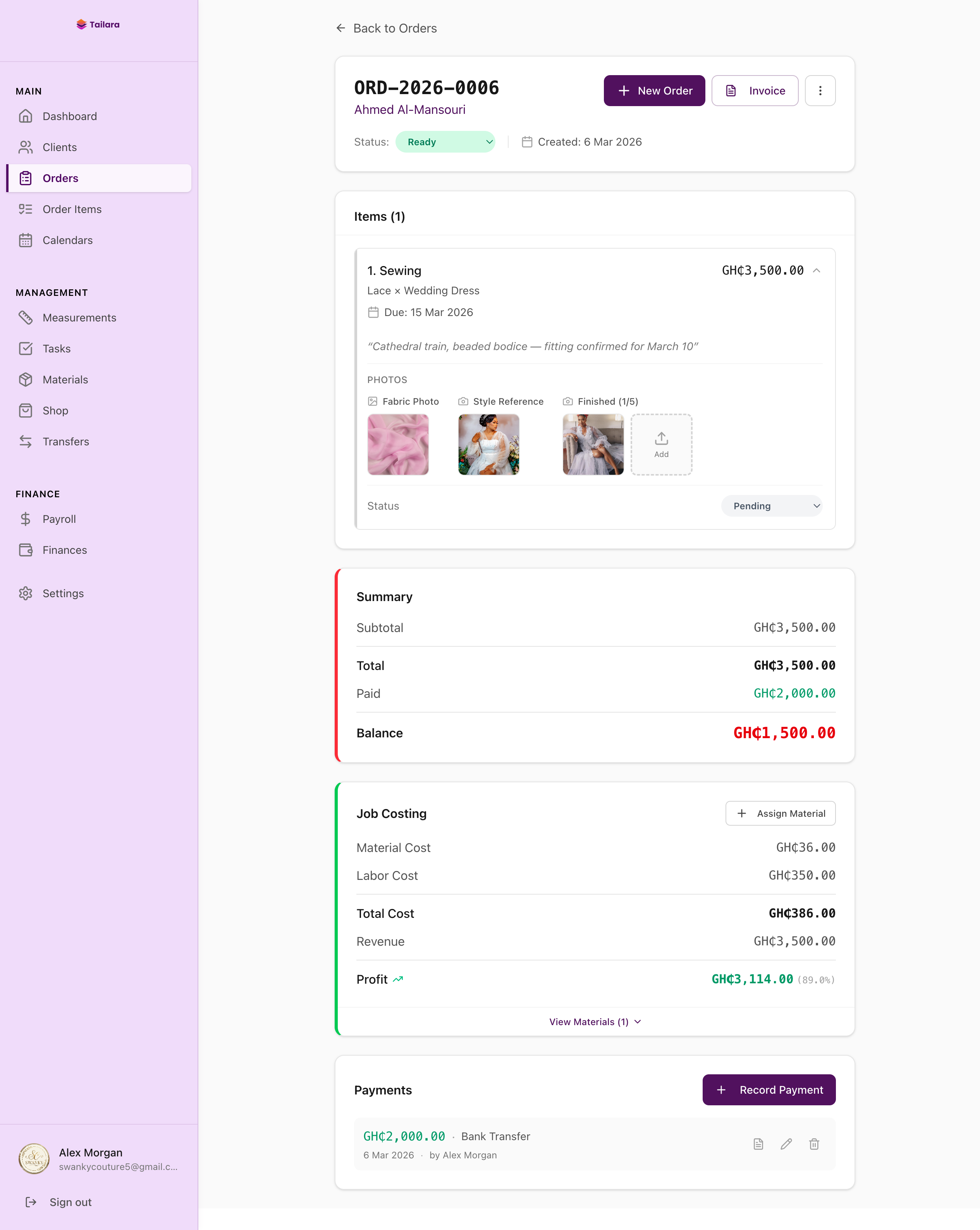
The fix is straightforward: every item in an order needs its own due date. Not every order — every item. A three-item order should have three deadlines, each one visible and trackable independently.
Trap 2: No early warning system
The worst time to discover a deadline is the day of. By then, your options are: rush the work, compromise quality, or call the client with bad news. None of these are good.
What you need is visibility three to five days ahead. If you can see on Monday that three outfits are due by Friday, you can plan your week around them. You can allocate staff. You can prioritise. You can identify problems before they become emergencies.
Most tailors only think about a deadline when the client calls to ask if it's ready. That's reactive. The tailors who build strong reputations are proactive — they know what's coming before it arrives.
Trap 3: Staff don't know what's urgent
You know that the blue lace dress is due tomorrow. But does your cutter know? Does your embroiderer know? If the deadline lives in your head or your personal notebook, your team is working blind. They're finishing tasks in whatever order feels right, which might not be the order that matters.
This is how you end up with three non-urgent items completed on time while the one urgent piece hasn't been started. It's not your staff's fault — they didn't have the information.
When everyone can see deadlines, everyone can prioritise. Your cutter sees that the wedding kaftan is due Friday and the casual shirt is due in two weeks. They cut the kaftan first. No conversation needed. No micromanaging.
Trap 4: No distinction between "order due" and "task due"
Here's a subtlety that trips up even experienced tailors. An order might be due on Saturday, but the cutting needs to happen by Wednesday, the sewing by Thursday, and the finishing by Friday. Those are three internal deadlines that feed into one client-facing deadline.
If you only track the final due date, you have no way to know whether you're on track until it's too late. The cutting should have started Monday, but nobody flagged it. Now it's Wednesday afternoon and three days of work need to happen in two days.
The solution is task-level deadlines — breaking each order item into steps, each with its own completion date. When the cutting task is due Wednesday, someone is accountable for it. If it slips, you know immediately, not on Friday when the client arrives.
What never missing a deadline looks like
Imagine opening your phone on Monday morning and seeing this:
This week: 7 items due. 3 need cutting today. 2 are in finishing. 2 haven't started — flag these.
Next week: 4 items due. All on track. No action needed.
Overdue: 1 item — Mrs. Adjei's skirt was due last Friday. Call her today.
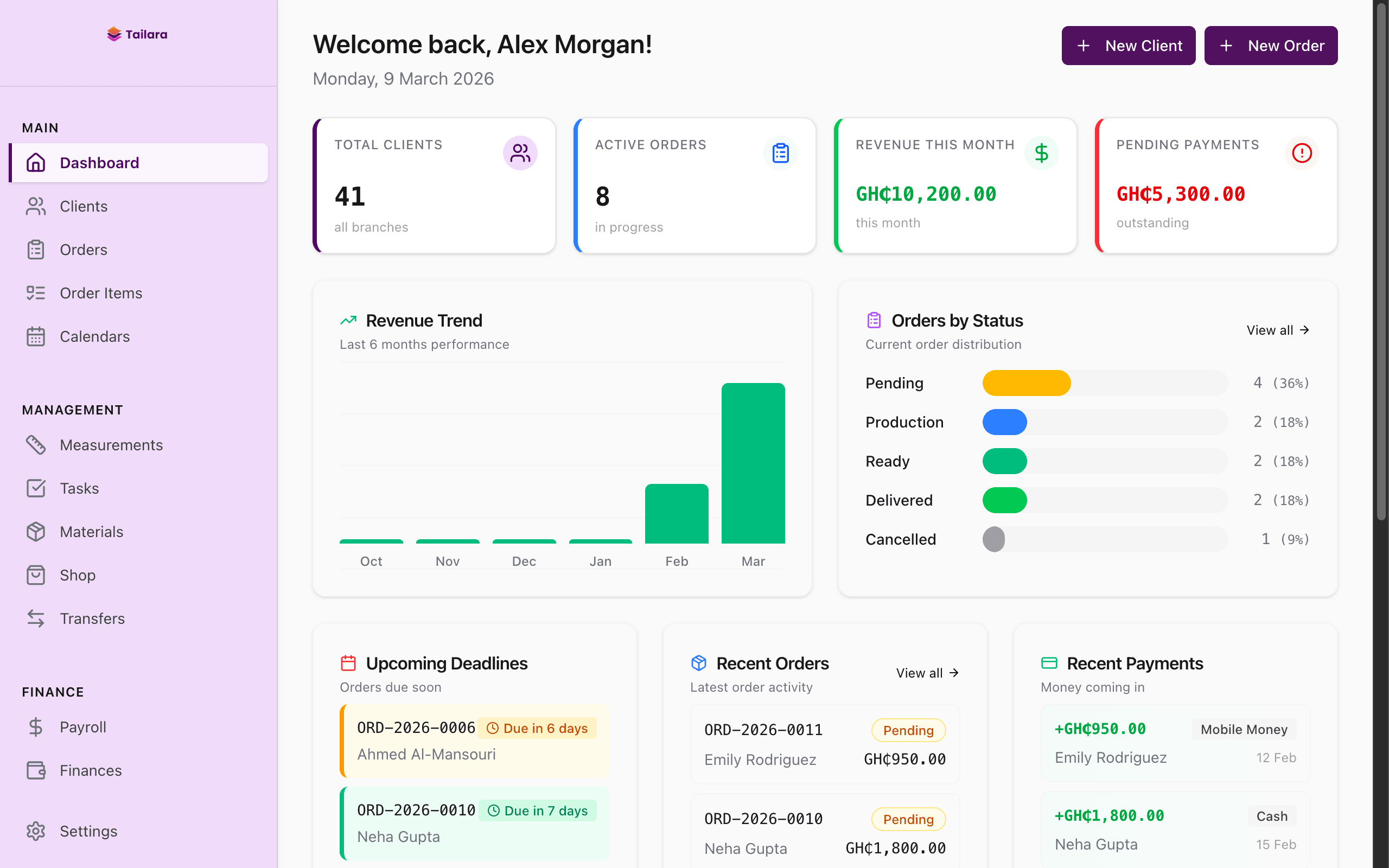
No scrolling. No checking notebooks. No trying to remember. Just a clear view of what needs your attention right now.
This is what a deadline system should give you — not just a list of dates, but an early warning system that tells you what's coming, what's on track, and what needs immediate action.
Every item has its own due date. Every task within that item has a completion target. Your staff see the same deadlines you do. And when something is about to slip, you know before the client does.
How tailors who never miss deadlines actually work
The pattern is consistent across every tailor we've studied who maintains a perfect delivery record. They do three things differently:
First, they set deadlines at the item level, not the order level. When a client orders three outfits, each outfit gets its own due date based on event dates, complexity, and current workload. This prevents the "forgotten third item" problem.
Second, they review upcoming deadlines daily. Not weekly. Not when they remember. Every morning, they look at what's due in the next five days and adjust their day accordingly. This takes less than two minutes but prevents nearly all deadline surprises.
Third, they make deadlines visible to their entire team. Whether it's a shared board, a printed list, or a digital system — the key is that everyone who touches an order can see when it's due. This eliminates the need for the owner to personally relay every deadline to every staff member.
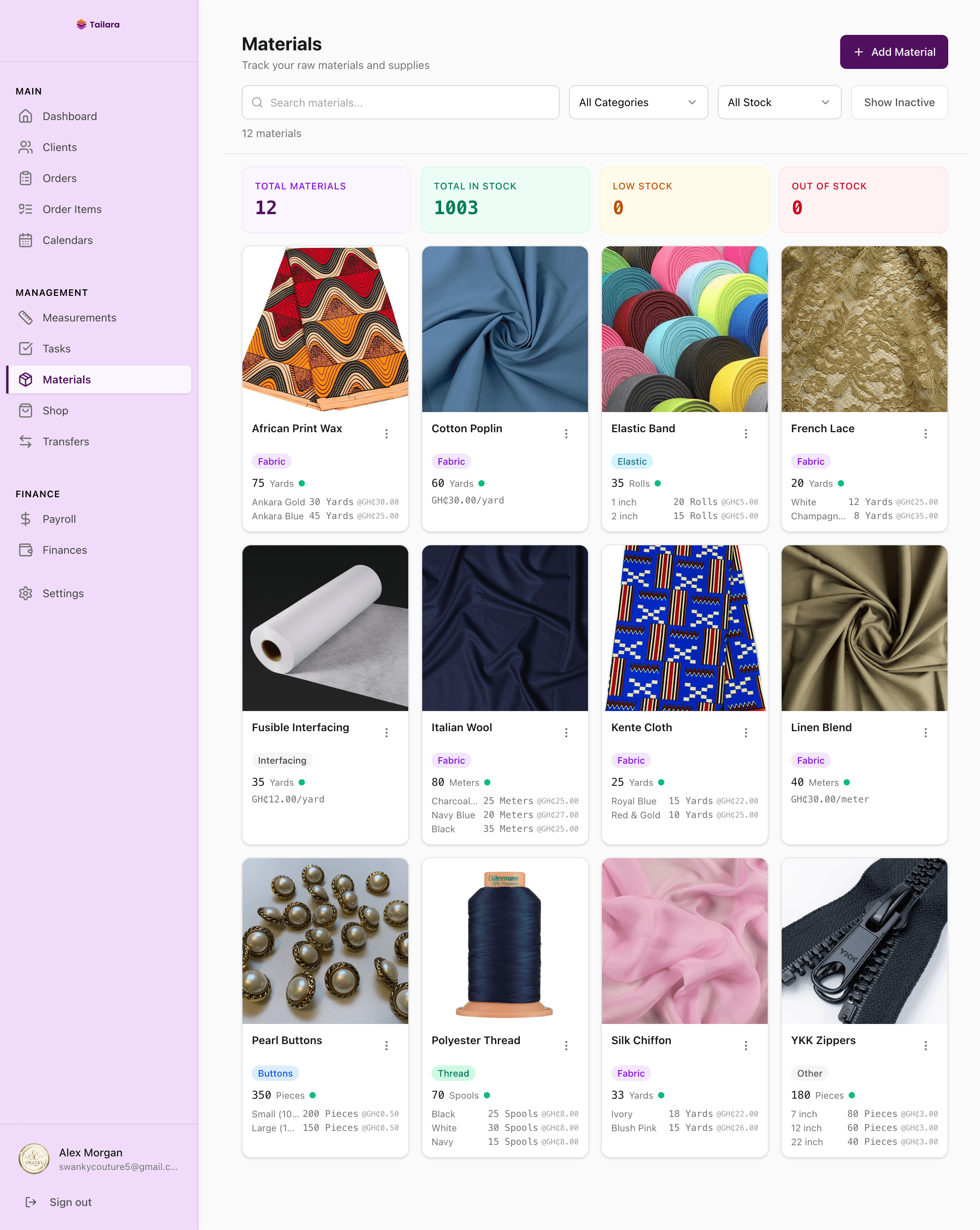
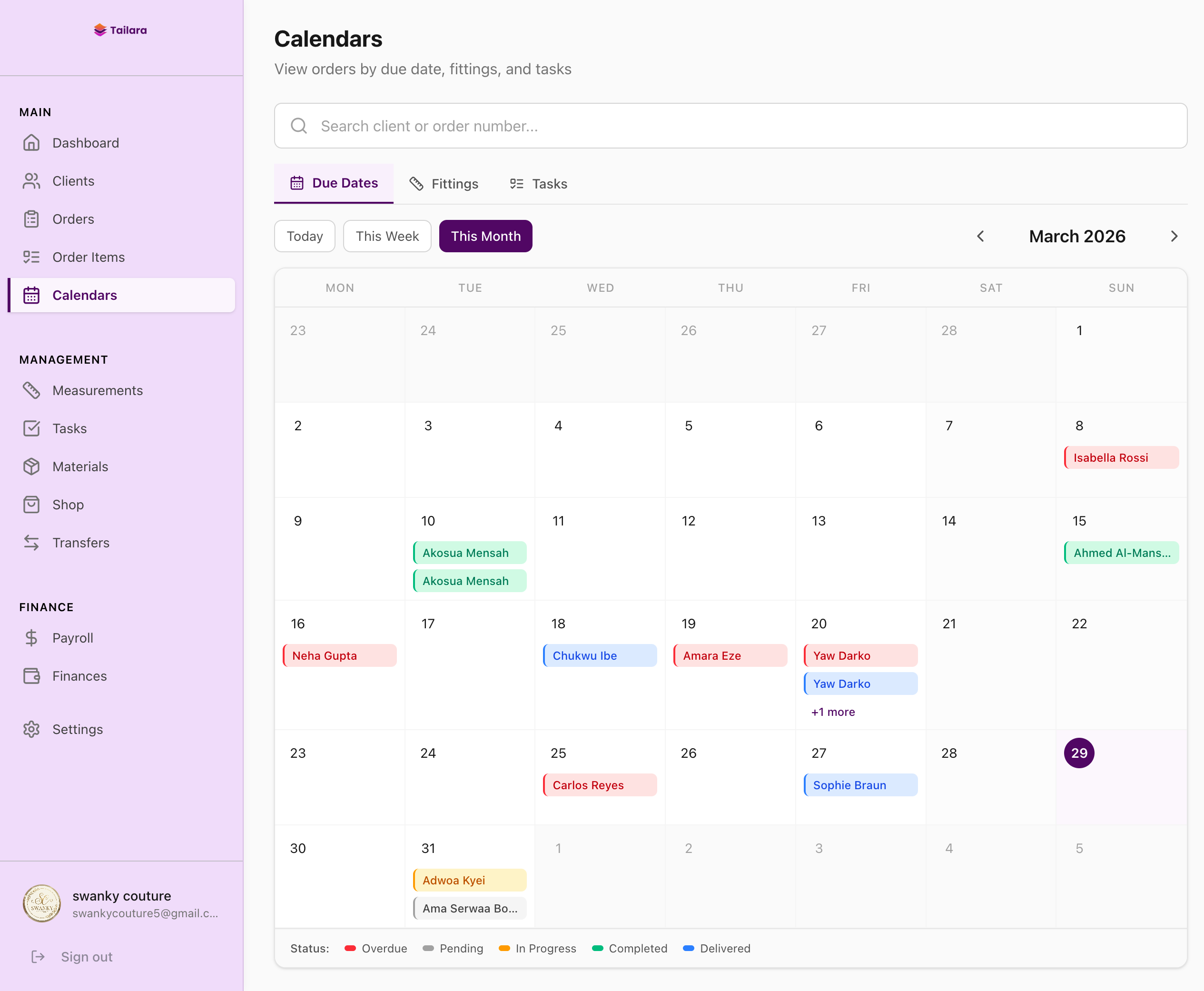
Tailara was built around these three principles. Every order item has its own due date. The dashboard shows upcoming deadlines the moment you log in. Your team sees the same calendar and task list you do. And overdue items are flagged in red so nothing slips past.
The calendar changes everything
Of all the features that transform how tailors manage their time, the calendar view is the one that creates the biggest shift in behaviour.
When your deadlines exist as a list — in a notebook, in your phone's notes app, or in your head — they feel abstract. "Due March 15" is just text. It doesn't connect to the rest of your week.
When you see those same deadlines on a calendar, suddenly the picture changes. You can see that you have four items due on Friday and nothing due on Wednesday. You can see that next week is light but the week after is packed. You can see that you've promised three outfits for the same day and one of them needs to move.
A calendar turns deadlines from something you react to into something you plan around. That's the difference between a tailor who's always stressed about time and one who's always in control of it.
Start with what's overdue
If you've been managing deadlines in your head or a notebook, here's the most valuable thing you can do right now: make a list of every active order and its due date. Every single one. Put them all in one place.
You'll probably discover two things. First, you have orders you'd forgotten about — items that were promised weeks ago and somehow fell off your radar. Second, you have multiple items due in the same window that you haven't planned for yet.
Both of these are fixable. But only once you can see them.
Tailara lets you enter all your active orders and due dates in under an hour. From that point forward, your dashboard shows what's due this week, what's coming next week, and what's overdue. Your calendar shows the full picture. Your team sees the same view.
Most tailors who set this up say the same thing: "I can't believe I was trying to keep all of this in my head."
14-day free trial. No credit card required. Set up your orders and deadlines on day one.
Tailara is a fashion business management platform built for tailors and fashion designers. Manage clients, measurements, orders, payments, tasks, and payroll — all in one place.