You bought 50 yards of that navy blue suiting fabric last month. You've made four suits from it. Each suit took about 3 yards. That's 12 yards used. So you should have 38 yards left.
But when you check the roll, it looks closer to 30. Maybe 28. You're not sure — you're eyeballing it.
Where did those 8 to 10 yards go?
You don't know. And that's the problem. Because at GH₵85 per yard, those missing yards represent GH₵680 to GH₵850 that simply vanished from your business. Not stolen necessarily. Not wasted intentionally. Just — gone. Unaccounted for. And it happens every single month, on every single roll, across your entire inventory.
This is the quiet leak that most tailoring businesses never plug.
Fabric is your largest expense — and your least tracked
Ask any tailor what their biggest cost is, and they'll say fabric. It's not rent. It's not salaries. It's not electricity. Fabric typically represents 40 to 60 percent of total expenses in a tailoring business.
Yet walk into most tailor shops in Accra, Lagos, Kumasi, or Abuja, and ask the owner exactly how many yards of each fabric they have in stock right now. Most can't tell you. Some will point at the shelves and say "it's all there." A few might have a notebook with purchase dates and quantities — but no running total that accounts for what's been used.
Now imagine running a restaurant where you don't track how much rice you have. Or a pharmacy where you don't count your tablets. It sounds absurd. But that's exactly what most tailoring businesses do with their most expensive asset.
The tailors who track fabric properly don't do it because they enjoy paperwork. They do it because they discovered what it costs not to.
The 5 ways fabric disappears from your shop
1. Over-cutting
This is the most common source of fabric loss, and it's rarely intentional. A dress requires 2.8 yards. Your cutter rounds up to 3.5 yards to be safe — "better to have extra than to run short." That sounds reasonable until you multiply it across every order.
If your cutter adds an extra half yard to 10 orders per week, that's 5 extra yards per week. At GH₵80 per yard, that's GH₵400 per week. GH₵1,600 per month. GH₵19,200 per year. All because of a habit that feels like caution but is actually waste.
The solution isn't to tell your cutter to use less fabric — that risks ruining garments. The solution is to know exactly how much each garment style requires and to track actual usage against that standard. When you can see that a particular style consistently uses 3.2 yards instead of the expected 2.8, you either adjust your pricing to reflect the real cost, or you investigate why the extra fabric is needed.
2. No record of what was used for which order
A client's ankara arrives at your shop. You cut it, sew it, deliver the outfit. But did you record that you used 4 yards of that fabric for Order #ORD-2026-0034? Almost certainly not.
This means you can never go back and verify. If the roll runs out faster than expected, you have no trail to follow. You can't compare actual usage against estimated usage because you never recorded the actual. Every yard leaves your inventory without a receipt.
This is like running a shop where products leave the shelf but never pass through the till. You know things are going — you just don't know where, when, or how much.
3. Staff taking small amounts
This is the one nobody wants to talk about. But if you employ cutters or assistants and you don't track fabric, you have no way to verify that every yard is going into client garments.
A half yard here. A yard there. It doesn't look like much. But across multiple staff over multiple months, it adds up to a serious cost. And the most difficult part is that without tracking, you can't tell the difference between legitimate waste and misuse. You're left with suspicion but no evidence — which is worse than having either clarity or ignorance.
Fabric tracking doesn't mean you distrust your staff. It means you've built a system where trust is backed by numbers. The best employers track not to catch people, but to remove the ambiguity that breeds suspicion in the first place.
4. Buying what you already have
You're at the fabric market. You see a beautiful chiffon that you think you've run out of. You buy 20 yards. When you get back to the shop, you find 15 yards of the same fabric on the shelf — you'd just forgotten it was there.
Now you have 35 yards of one fabric and you've spent money you didn't need to spend. Or worse, you needed that cash for a different fabric that you actually have run out of, but you won't discover that until a client asks for it and you check.
Without a stock count you can check from your phone, every trip to the fabric market is a guessing game. You over-buy some fabrics and under-buy others. You tie up cash in inventory you don't need while running short on materials you do.
5. Promising fabric you don't have
A client calls and asks if you can make an outfit from the emerald green silk she saw last time she visited. You say yes — you're pretty sure you still have some. She pays the deposit.
When you check the shelf, there's barely a yard left. Not enough for what she wants. Now you need to source more of the exact same fabric, which might not be available. Or you need to call the client and explain the situation, which is embarrassing and unprofessional.
This happens because your stock level exists only on the shelf — not in a system you can check before making promises. If you could pull up your phone and see "Emerald Green Silk: 1.2 yards remaining" before answering the client's call, you'd either confirm the order or set expectations honestly. Both are better than promising and failing.
What proper fabric tracking actually looks like
Tracking fabric isn't complicated. It's three things done consistently:
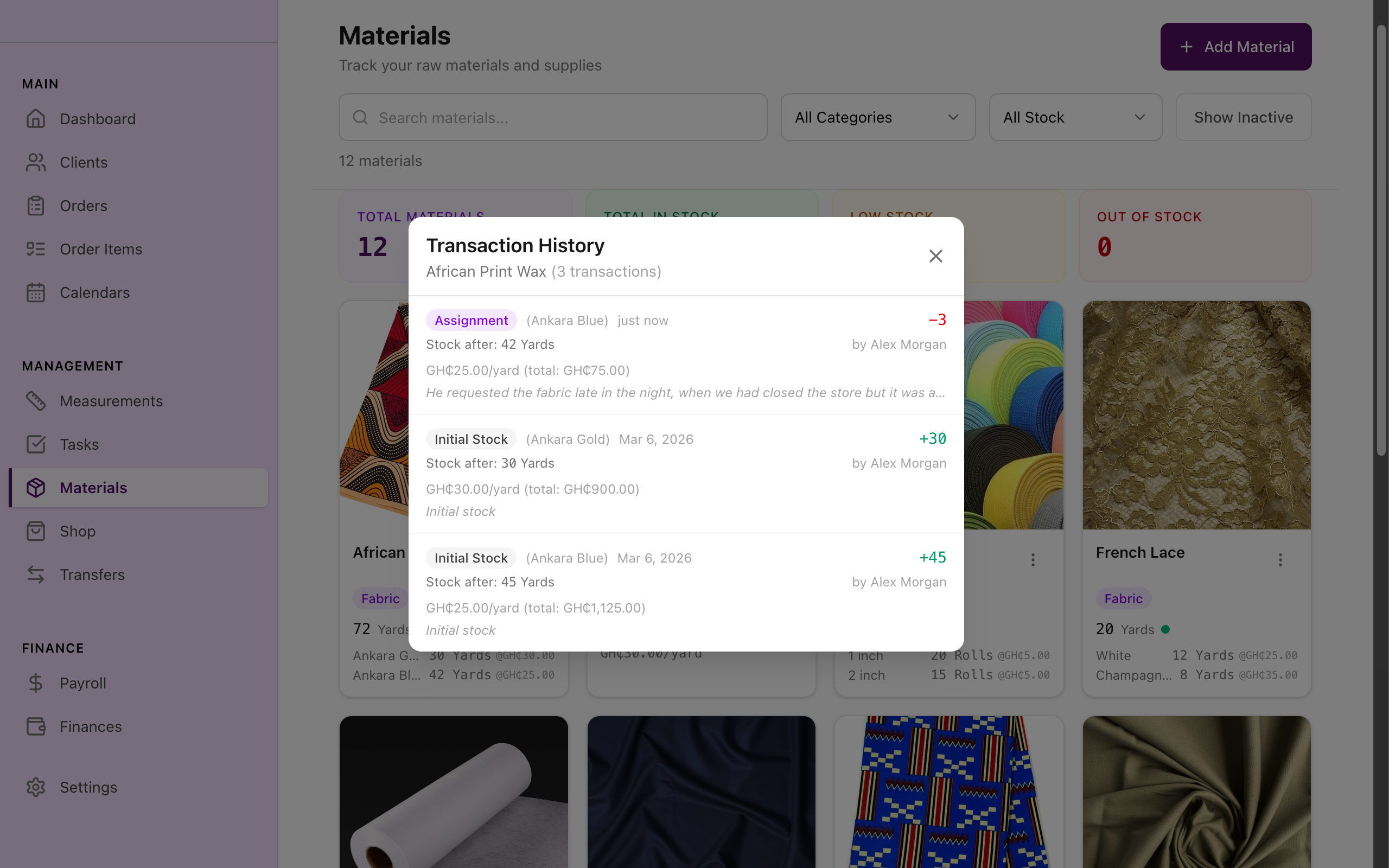
Record what comes in. When you buy 50 yards of a fabric, that goes into the system with the date, supplier, cost per yard, and total cost. Now you have a starting balance.
Record what goes out. When you cut 3 yards for an order, you log it against that order. Now the system knows you have 47 yards left, and it knows exactly where those 3 yards went.
Check the balance. At any point, you can see how many yards you should have. If the physical roll doesn't match the system, you know there's a discrepancy — and you can investigate it while the trail is fresh, not six months later when you've lost track entirely.
This is what manufacturers, retailers, and restaurants have done for decades. The tailoring industry is one of the last to adopt it, mostly because the tools available were built for warehouses and shops, not for fabric rolls and garment production.
When your fabric has a paper trail, everything changes
The moment you start tracking fabric at the transaction level, several things shift in your business.
Your pricing gets honest. You discover that the outfit you've been charging GH₵1,200 for actually uses GH₵680 in fabric, not the GH₵500 you estimated. Your margins are thinner than you thought. Now you can adjust your pricing to reflect reality, or you can find ways to reduce material usage.
Your staff become accountable. Not through surveillance — through transparency. When every yard is recorded, the question isn't "are they stealing?" It's "does actual usage match expected usage?" If it doesn't, you have a conversation based on data, not suspicion.
Your purchasing becomes strategic. Instead of guessing what to buy at the fabric market, you check your inventory levels before you leave the shop. You buy what you need. You don't buy what you already have. Your cash stays available for materials that will actually generate revenue.
Your clients get honest answers. When someone asks if you have a specific fabric in stock, you check your phone and give them a definitive answer. No guessing, no embarrassment, no broken promises.
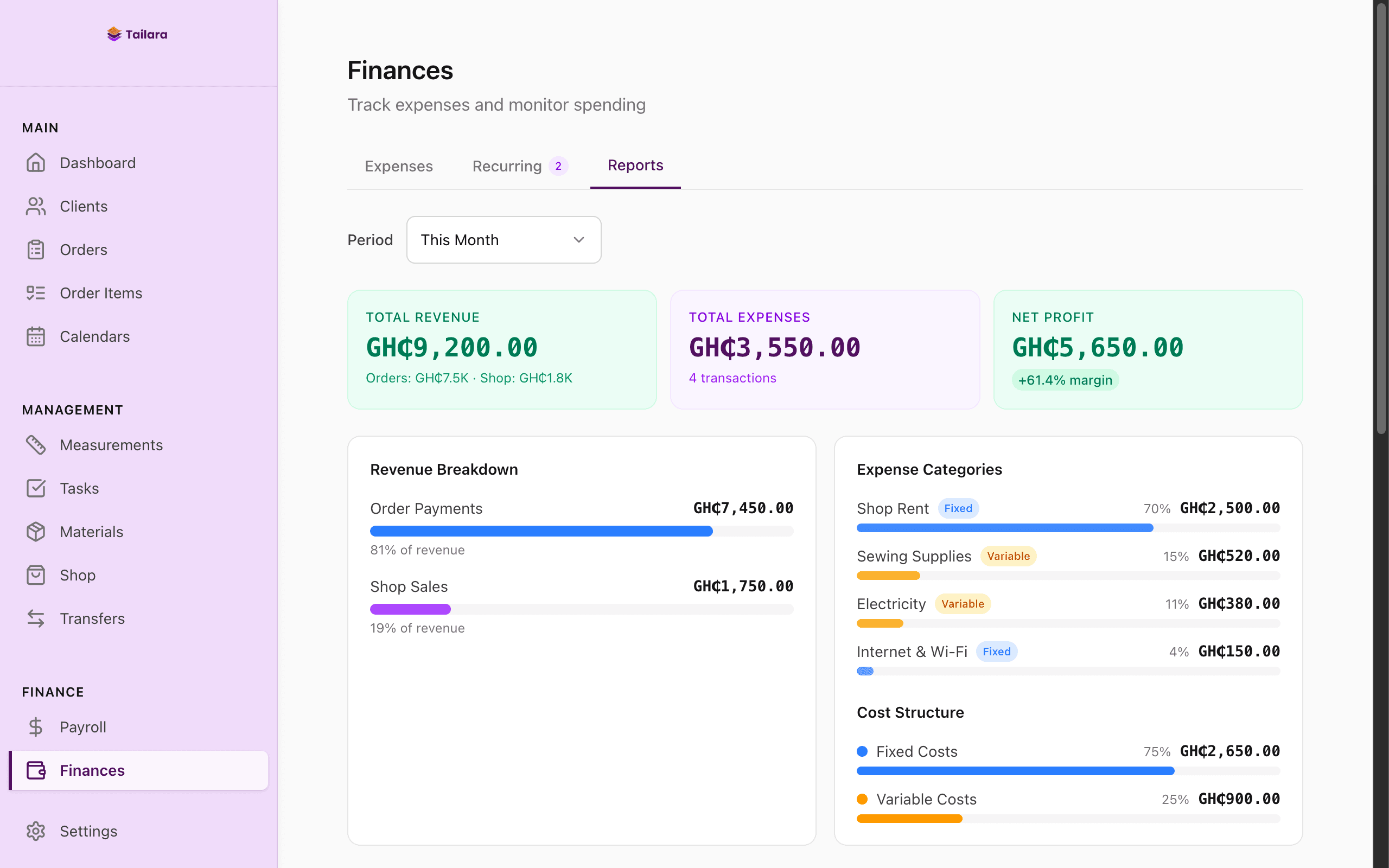
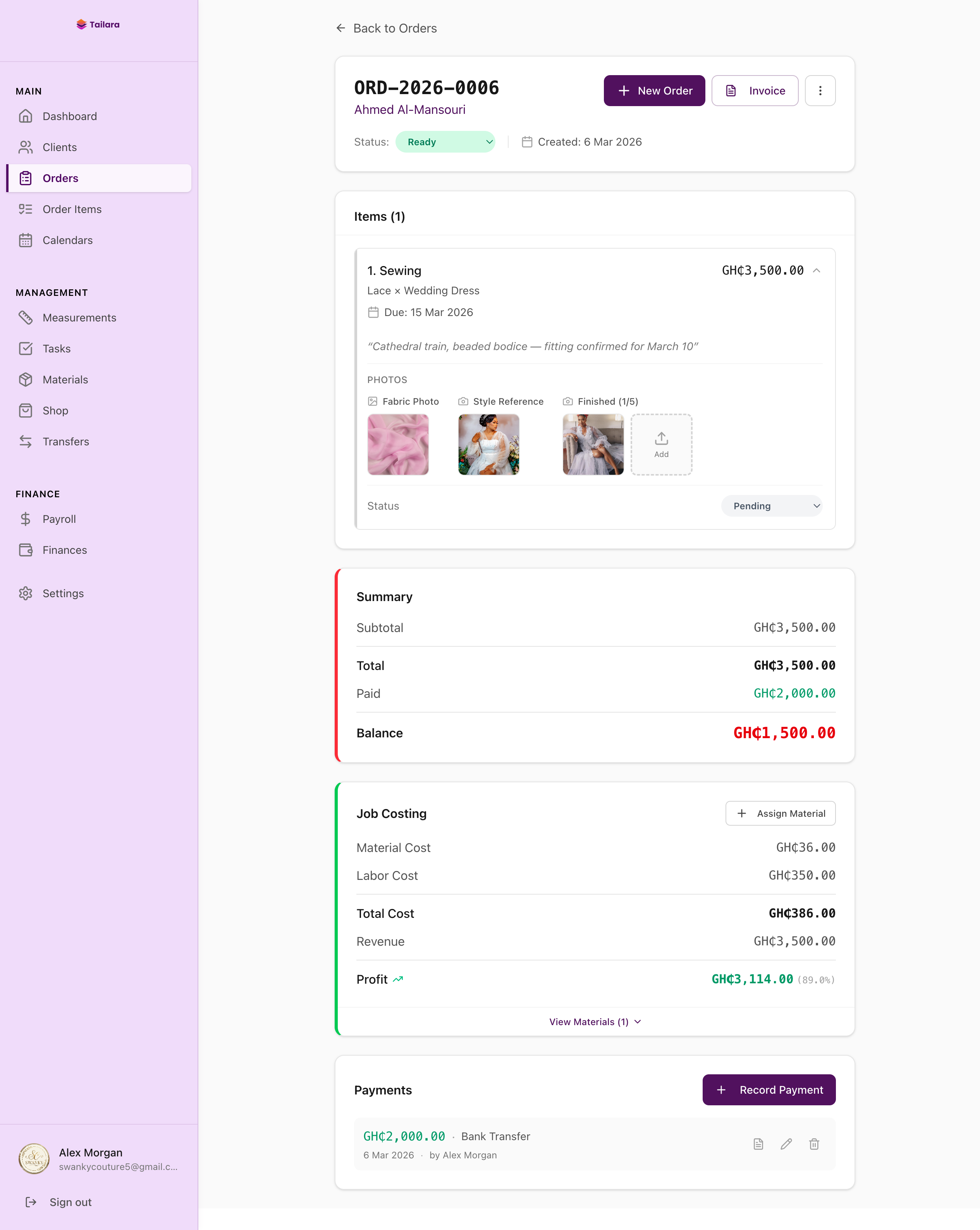
Your profit margins become visible. For every order, you can see: client paid GH₵1,500, fabric cost was GH₵620, labour was GH₵300, profit was GH₵580. Without tracking fabric, that GH₵620 number is a guess. With tracking, it's a fact.
"But I'm not big enough to need inventory tracking"
This is the most common objection, and it's backwards.
Inventory tracking isn't something you need because you're big. It's something that helps you get big. The tailor with 10 orders per month who tracks fabric knows their exact costs, sets accurate prices, and builds healthy margins from day one. The tailor with 10 orders per month who doesn't track is guessing — and often undercharging because they don't realise how much fabric each job really costs.
The tailors who grow to 50, 100, 200 orders per month almost always say the same thing: "I wish I'd started tracking from the beginning."
You don't need a big shop, a warehouse, or a team of staff to benefit from knowing where your fabric goes. You just need to care about your money. And if you're reading this, you clearly do.
Start with your most expensive fabrics
You don't need to track every scrap of fabric on day one. Start with your top 5 most expensive materials — the ones where a missing yard actually hurts.
Enter them into a system with their current approximate yardage. From this point forward, log what you use for each order. Within a month, you'll have real data on your actual fabric consumption. You'll see patterns. You might be surprised.
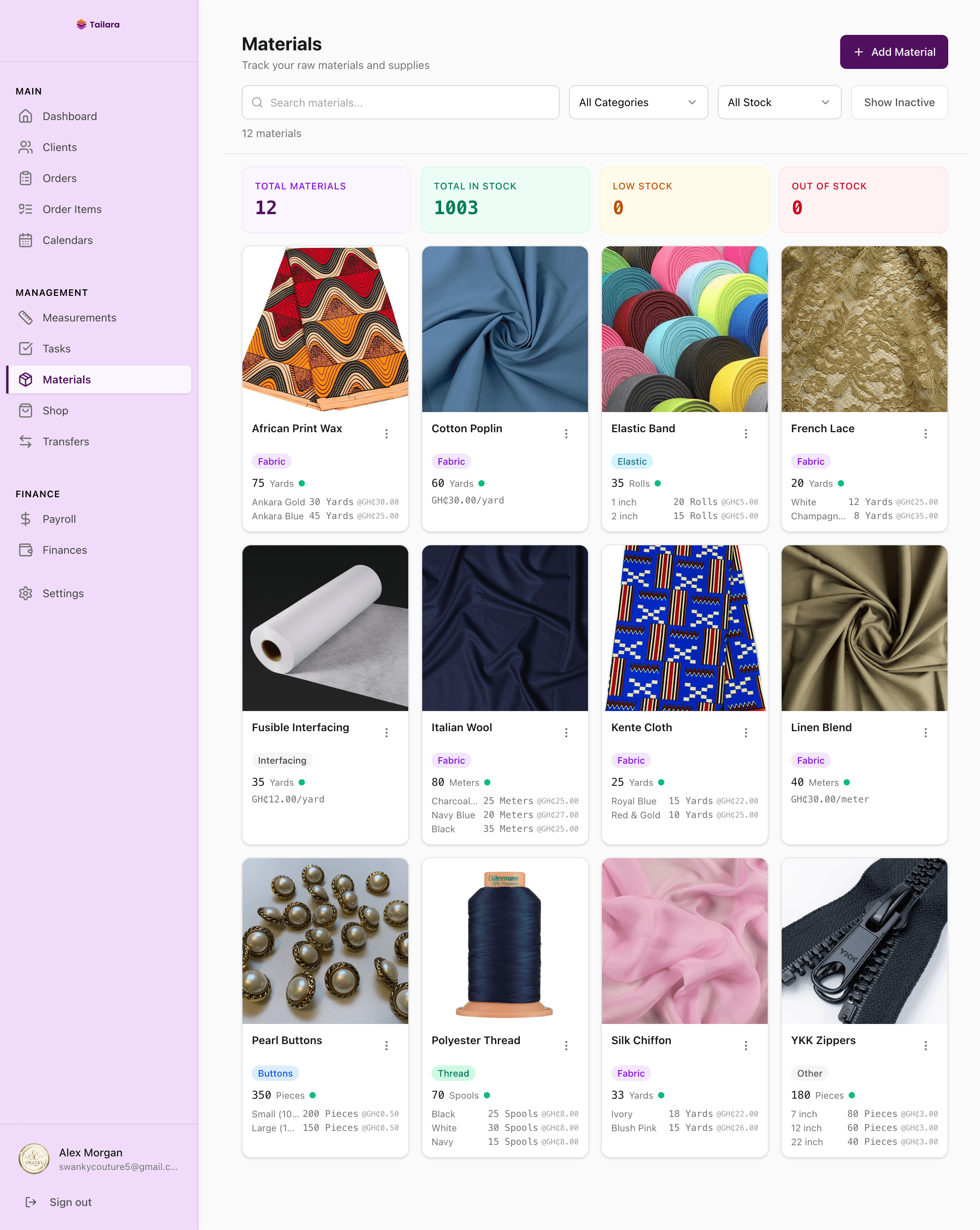
Tailara's material inventory tracks every fabric by type, variant, colour, and quantity. Every stock movement is logged with a timestamp — what came in, what went out, and which order it was assigned to. The ledger is immutable, meaning entries can't be quietly deleted or altered. Your staff can log usage from their phones. You can check stock levels from anywhere.
Most tailors set up their initial inventory in under 30 minutes. Within a week, they have more visibility into their fabric costs than they've had in years.
14-day free trial. No credit card required. Start tracking your most valuable asset on day one.
Tailara is a fashion business management platform built for tailors and fashion designers. Manage clients, measurements, orders, payments, tasks, and payroll — all in one place.