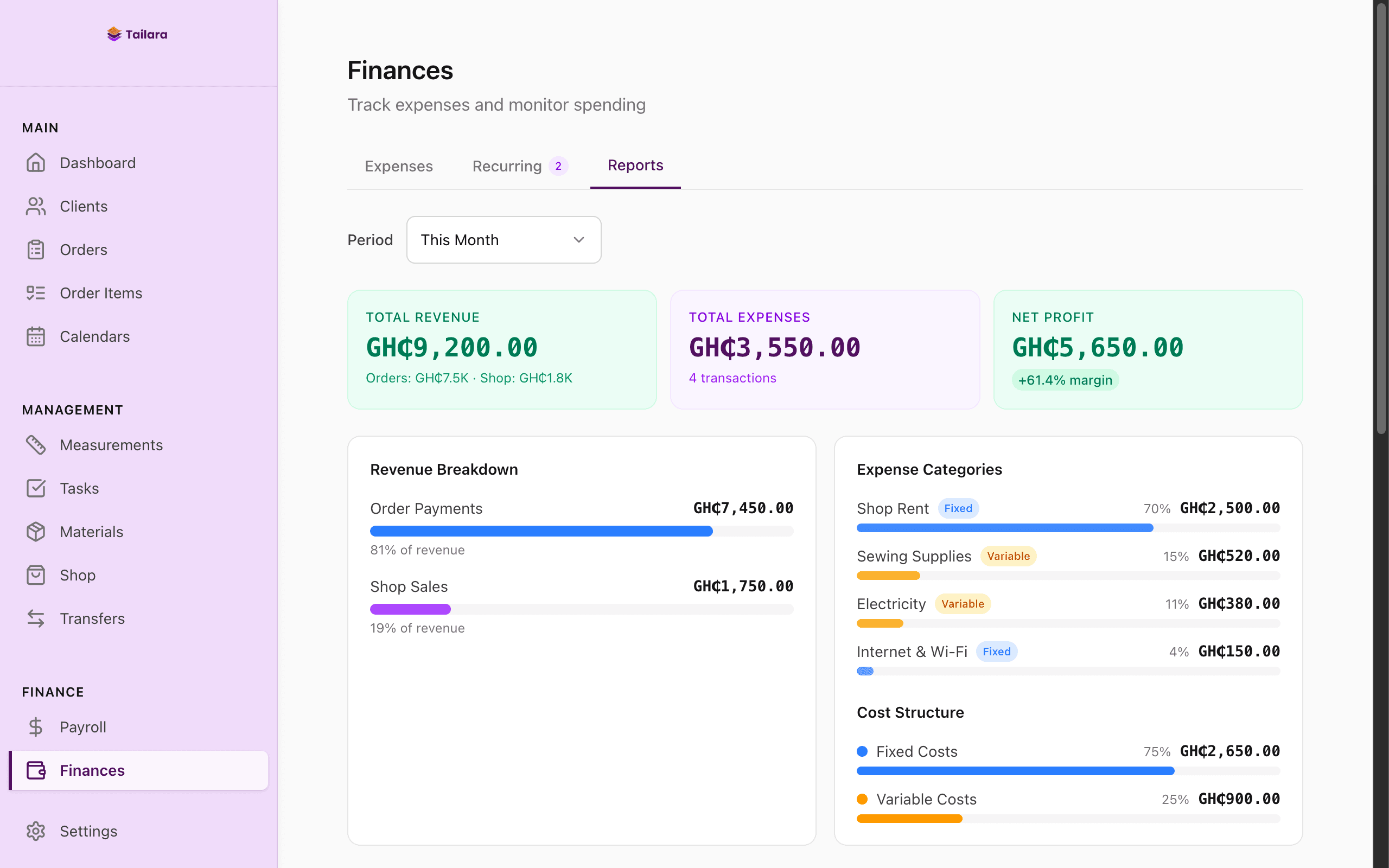
Revenue is not profit. Every tailor knows how much money comes in, but very few know how much they actually keep after materials, labour, rent, and other costs.
This post breaks down the numbers that separate thriving tailor shops from those that struggle despite being busy.
The metrics that matter
There are five numbers every tailor shop should track regularly. Most shops track one or two at best.
| Metric | What it tells you | How often to check |
|---|---|---|
| Revenue per month | Total money coming in | Monthly |
| Cost per garment | Materials plus labour for each order | Per order |
| Profit margin | What you keep after all costs | Monthly |
| Average order value | How much each client spends | Monthly |
| Client return rate | How many clients come back for a second order | Quarterly |
If you are only tracking revenue, you are seeing less than half the picture.
Revenue per month
This is the most basic number and the one most tailors already know. It is the total amount clients pay you in a given month.
But revenue alone is misleading. A shop doing 50,000 GHS per month in revenue might be less profitable than one doing 30,000 GHS if the first shop has higher material costs, more staff, and larger rent.
Track revenue monthly, but never let it be the only number you watch.
Cost per garment
This is the number most tailors ignore. For every garment you produce, there is a real cost: fabric, thread, buttons, zippers, interfacing, labour hours, and a share of your overhead.
Here is an example breakdown for a typical custom dress:
| Cost item | Amount (GHS) |
|---|---|
| Fabric (3 yards) | 180 |
| Thread and notions | 15 |
| Labour (6 hours at 15 GHS/hr) | 90 |
| Overhead allocation | 25 |
| Total cost | 310 |
If you charge 450 GHS for this dress, your profit is 140 GHS, a margin of about 31 percent. If you charge 350 GHS, your profit drops to 40 GHS, a margin of just 11 percent.
Most tailors set prices based on what feels right or what competitors charge. Knowing your actual cost per garment lets you set prices based on facts.
Profit margin
Your profit margin is the percentage of revenue you keep after all costs. A healthy tailor shop should aim for 25 to 40 percent margins on custom work.
| Margin range | What it means |
|---|---|
| Below 15% | Underpricing or high costs. Unsustainable long term. |
| 15% to 25% | Breaking even after overhead. Room for improvement. |
| 25% to 40% | Healthy business. Covering costs and building savings. |
| Above 40% | Excellent. Reinvest in equipment, staff, or marketing. |
If your margins are below 25 percent on most garments, review your pricing or look for ways to reduce material waste.
Average order value
This tells you how much the typical client spends per order. To calculate it, divide your monthly revenue by the number of orders completed that month.
A low average order value means you are doing many small jobs. A high value means fewer but more profitable jobs. Neither is inherently better, but knowing the number helps you decide where to focus.
If your average order value is 200 GHS and you want to grow revenue without adding more clients, you could offer add-ons: matching headwraps, alterations to existing garments, or rush delivery for a premium.
Client return rate
Acquiring a new client costs time and effort. A returning client already trusts you, already has measurements on file, and is likely to spend more.
Track how many of your clients place a second order within 12 months. A healthy return rate is 40 percent or higher. If yours is below 30 percent, something is driving clients away: missed deadlines, fit issues, or poor communication.
How to start tracking
You do not need complex software to begin. A simple monthly review works:
- Add up all revenue for the month
- Calculate the total cost of materials purchased
- Subtract materials from revenue for a rough profit estimate
- Count the number of orders completed
- Divide revenue by order count for your average order value
Do this for three months and you will already see patterns you never noticed before.
For more detailed tracking, Tailara calculates all of these metrics automatically. Job costing shows your profit per order, the dashboard shows revenue trends, and client profiles show return history.
The bottom line
Being busy is not the same as being profitable. The tailors who thrive long term are the ones who know their numbers and make decisions based on data, not guesses.
Start with one metric. Track it for a month. Then add another. Within a quarter, you will have a clearer picture of your business than most competitors ever will.